Section Resources
Overvoltage Overview Brochure:
English | Español
More Info:
Understanding Braking
NOTE: The files above are in Adobe PDF format. The free Adobe Reader is available below.
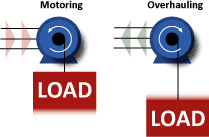
The need for regenerated voltage control occurs in applications where the speed of the AC motor exceeds that of its variable frequency drive (VFD). In these cases, the motor acts as a generator. The energy generated by the motor must be dissipated as heat or returned to the power line. If this energy is not controlled, the drive may trip on an overvoltage condition, the energy may be dissipated as heat in the motor, or the motor may run with an excessively high Volt/Hertz ratio. Either situation can cause extensive damage to the costly motors and result in loss of materials and stops in production.
Bonitron offers several solutions to control overvoltage problems. These solutions are available in two main categories: Braking and Regeneration. Both are available with optional Diode Sharing accessories.
Braking
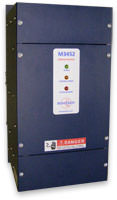
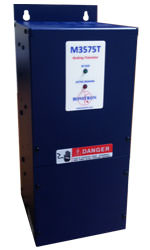
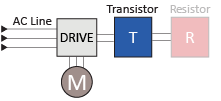
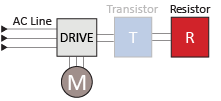
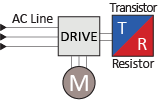
Resistive Braking Modules are typically used in applications where infrequent, low duty cycle, or low hp regeneration occurs. The standard duty cycle for the Braking Modules is 20% or less. When resistive braking is used, the regenerated energy is dissipated as heat. Bonitron’s M3452 and M3575T Braking Modules work with AC drives that use a fixed DC bus. When the drive’s DC bus voltage exceeds a fixed setpoint, the brake module’s control electronics turn on an IGBT transistor in a PWM mode connecting the resistor load across the DC bus. The regenerated energy is then dissipated as heat in the load.
Regen
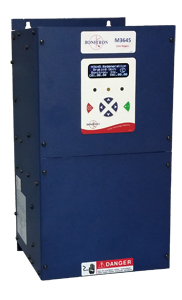
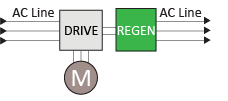
Applications with duty cycles exceeding 20% should consider the Bonitron M3345 Line Regen Modules. The preferred solution for medium to high duty cycles is to place dissipated energy back into the AC line. The Bonitron M3345 Line Regen returns the regenerated energy to the AC line with 95% efficiency! This regenerated energy can be used to power other equipment, providing remarkable energy cost savings. The slightly higher cost of the Line Regen is quickly offset in energy savings. Applications in which it may be impractical to dissipate the excess heat associated with the resistive loads are ideal candidates for the Line Regen.
Diode Sharing
Bonitron’s M3345D Diode Sharing modules are designed to offer system integrators a low cost solution for providing either line regeneration or dynamic braking for multiple drives. The M3345D modules provide blocking diodes that isolate the drives from each other while still establishing a shared, common regen or braking bus. This eliminates the problems encountered with older approaches.


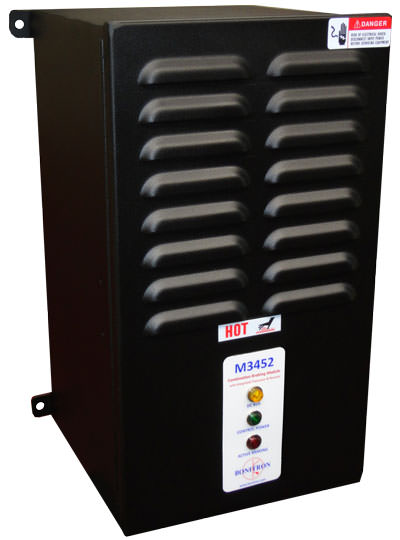
M3452 Heavy Duty Braking Transistor
- Up to 1200hp : Up to 100% Duty -
M3452 Heavy Duty Braking Modules provide drive protection from overvoltage faults due to regenerated voltage. They consist of braking transistor modules that contain braking chopper control electronics. Heavy duty modules are rated up to 1200 Amps and UL & CUL modules are available.
M3575T Standard Duty Braking Transistor
- 15 to 600hp : 20% Duty -
The M3575T modules are designed to be used with drives that do not include a braking transistor. They monitor the DC drive bus levels and control the IGBT power switch that connects the load across the bus.
M3675T Low HP Braking Transistor
- 0.5 to 10hp : 20% Duty -
Bonitron’s M3675T Low HP Baking Transistor is intended for use with drives without an internal brake. The module is easily installed with connections made to the drive DC bus and to an external braking resistor.
M3775RK Resistive Load Banks

- 10 to 100% Duty -
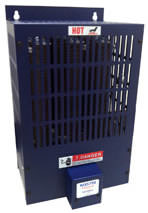
Bonitron understands that no one resistor technology can suffice for all resistive needs so we offer a wide range to meet your application needs. Some of which can withstand temperatures up to 800° C. Please see the M3775RS Brochure for more information.
M3575R Standard Duty UL Braking Resistor
- 1 to 33hp : 6 to 20% Duty -
M3575R modules may be used with drives with internal or external braking transistor modules. Bonitron M3575R modules are UL & CUL Certified, denoting a high level of quality.
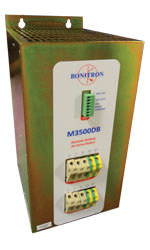
M3500DB Dynamic Safety Brake Modules
- for Servo Motion Control Systems -
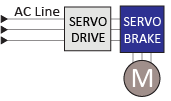
The standard M3500DB provides resistive E-stop braking control for servo motion systems and conforms to category II safety requirements per EN-954. The M3500DB4 incorporates redundant, positive guided contactors to satisfy category IV safety requirements per EN-954. The M3500DB is the secondary brake and will stop the motor in case of motion controller or power failure, as well as isolate the motor from its power source once it is stopped to ensure personal safety.


M3345 Line Regens
- Up to 100hp : 100% Duty -
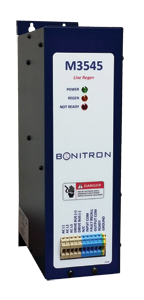
In applications with extended braking times, high horsepower, or where frequent regeneration occurs, the M3345 is the most economical solution due to substantial energy savings! When a resistive absorber kit is used, the regenerated energy is dissipated as heat and the energy is wasted. With Bonitron’s M3345 Regen Module, the regenerated energy is returned to the input AC line at 95% efficiency. Substantial energy savings result as the regenerated energy can now be used to power other equipment and the cooling requirements for the control room are reduced.
Also, today’s system integrators are demanding smaller and smaller variable frequency drive packages. Therefore, Bonitron offers the standard Line Regen in a smaller enclosure. The tall and thin “servo” or “bookshelf” chassis mirrors the latest in drive designs. The M3345 Type-1 “bookshelf” chassis offers the same protection and operation as the Bonitron Type-13 Regen in the convenience of a small package. The Type-1 chassis is an ideal solution for applications where space is limited.

M3345D Diode Sharing Modules
The M3345D modules provide blocking diodes that isolate the drives from each other while still establishing a shared, common regen or braking bus. This eliminates the problems encountered with the older approaches. The M3345D modules can be used in two configurations. The first, several drives, each producing a small amount of regenerated energy and sharing a line regen module large enough to handle the sum total amount of regenerated energy. Secondly, multiple drive applications which have regeneration occurring on only one drive at a time (an example is an overhead crane system which is lifting or only moving in one axis at a time).